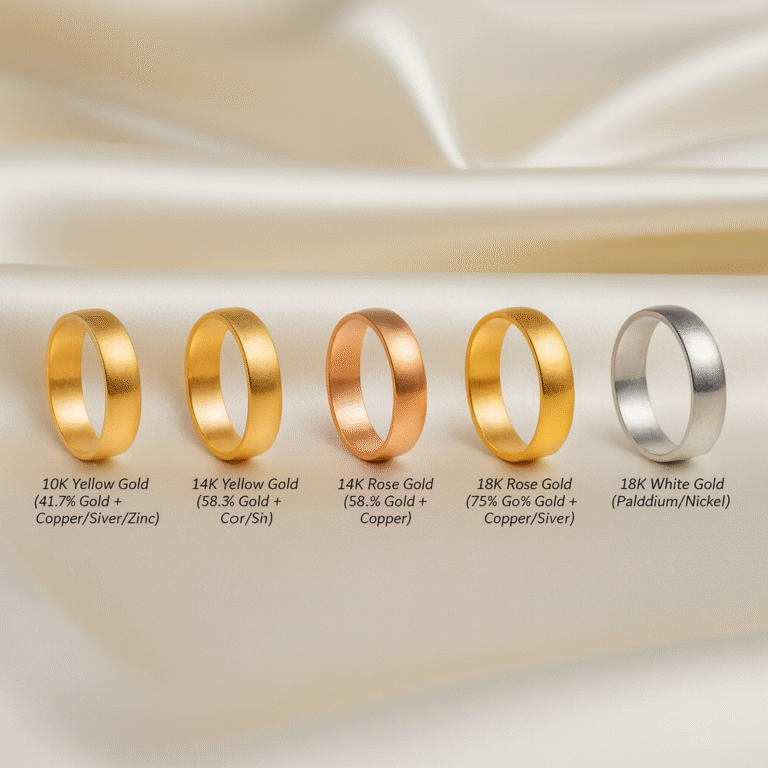
we navigate the choppy economic waters of 2026, gold has once again proven its mettle as the ultimate safe haven. With central banks globally increasing their reserves and inflation remaining a persistent concern for investors from New York to New Delhi, the “yellow metal” is hitting historic milestones in the commodity markets. Whether you’re an American investor eyeing a 401k rollover into physical gold or an Indian family preparing for Dhanteras jewelry purchases, knowing the exact value of your holdings is crucial. But how is that value derived?
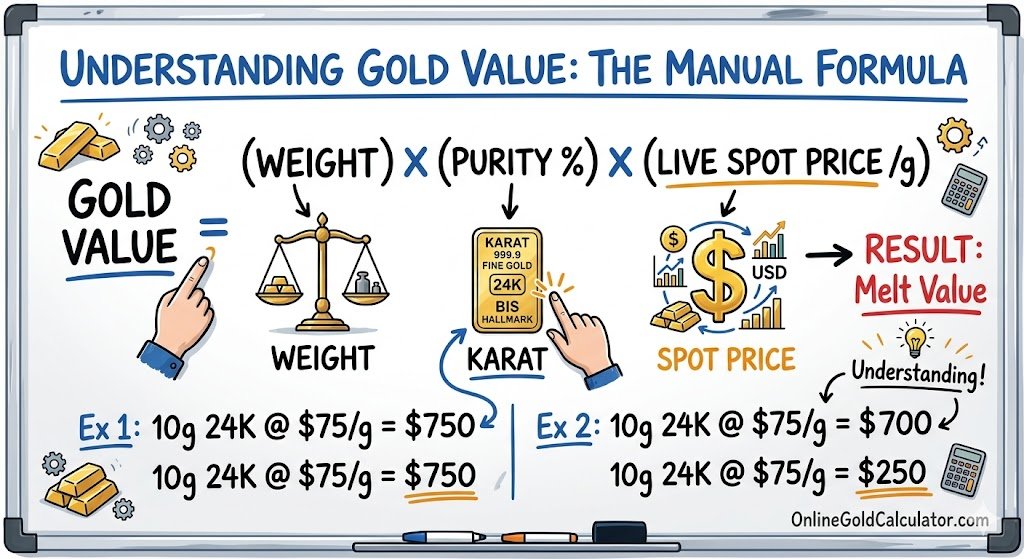
While an online tool like our Online Gold Calculators offers instant precision, understanding how to calculate gold price manually empowers you as a buyer and seller. The underlying formula is straightforward: (Weight of Gold $\times$ Purity %) $\times$ Current Spot Price. The complexity arises only in interpreting the purity and accounting for market specifics like premiums in the US or making charges and Hallmark (BIS) standards in India. This article will deconstruct these variables, transforming you from a passive price-taker into a savvy precious metals analyst.
Quick Summary: Key Takeaways
- The Baseline Formula: (Weight $\times$ Purity %) $\times$ Spot Price = Material Value.
- Spot Price is Global: The base price of gold is the same globally, usually quoted per troy ounce (31.103 grams) for 24K.
- Purity Matters: 24K is 99.9% pure; 22K is 91.6% pure. You must apply this decimal (0.999 or 0.916) to the spot price for accurate valuation.
- USA Focus: Investors pay the spot price plus a “premium” or markup, which covers minting and dealer profit.
- India Focus: Consumers pay for the gold weight (usually 22K), a 3% GST, plus variable “making charges” for jewelry.
Step 1: Determine the Weight of Your Gold
The first variable you need is the weight. Gold is weighed using different units depending on the region and the type of gold product.
The Gram vs. The Troy Ounce
In the international market, the spot price of gold refers to one troy ounce of 24-karat gold. A troy ounce is not the same as a standard avoirdupois ounce (the kind used for food scaling in the US). A troy ounce is heavier, weighing precisely 31.1034768 grams.
If you possess small coins or jewelry, you will most likely measure the weight in grams. If you have larger investment bars, they are typically denominated in troy ounces or kilograms.
The Indian Context: The Tola
In India, the Tola is a widely recognized traditional unit. While many modern jewelers are moving toward grams for transactional clarity, consumers often still think and negotiate in Tolas. A standard Indian Tola is accepted as 11.66 grams, though some traditional computations use exactly 10 grams for simplicity.
Expert Insight: Never trust a dealer’s weight estimate. Always use a calibrated digital scale yourself to determine the exact weight in grams before performing any manual calculation. Even a one-gram discrepancy at 2026 prices can mean a loss of over $70 (approx. ₹5,800).
| Weight Unit | Equivalent in Grams | Equivalent in Troy Ounces |
| 1 Gram | 1.00 g | 0.03215 oz t |
| 1 Troy Ounce | 31.1035 g | 1.00 oz t |
| 1 Standard Ounce | 28.3495 g | 0.911 oz t |
| 1 Kilogram | 1,000 g | 32.1507 oz t |
| 1 Tola (India) | 11.6638 g | 0.375 oz t |
Step 2: Understand and Confirm the Purity (Karat)
The purity of your gold dictates how much of the total weight is actually gold, and how much is alloy. This factor is expressed in Karats (K) or Fineness.
24K Gold (Pure Gold)
24K gold is the highest purity possible, consisting of 99.9% pure gold (expressed as .999 fineness). It is distinctively rich, bright yellow, but too soft to be durable. This is why 24K is almost exclusively used for investment vehicles like bars and official sovereign coins (e.g., Canadian Maple Leafs or American Buffalos), but rarely for jewelry.
22K Gold (Jewelry Standard)
22K gold contains 22 parts gold and 2 parts of another metal alloy (copper, silver, zinc, or nickel). This 91.6% purity makes the metal harder and much more suitable for intricate jewelry. In India, Middle East, and parts of Southeast Asia, 22K is the standard for bridal and investment jewelry, striking a balance between value and durability.
The Fineness Scale
Professionals often use the millesimal fineness scale instead of Karats. The table below provides the essential conversion rates you will need when you calculate gold price manually.
| Karat Rating | Purity Percentage | Millesimal Fineness | Calculation Decimal | Common Use Case |
| 24K | 99.9% | .999 | 0.999 | Investment Bars/Coins |
| 23K | 95.8% | .958 | 0.958 | Thai Baht Gold |
| 22K | 91.6% | .916 | 0.916 | Indian Jewelry |
| 21K | 87.5% | .875 | 0.875 | Middle Eastern Jewelry |
| 18K | 75.0% | .750 | 0.750 | Stone-set Jewelry |
| 14K | 58.3% | .583 | 0.583 | Standard US/EU Jewelry |
| 10K | 41.7% | .417 | 0.417 | Class Rings/Value Jewelry |

Expert Insight: In India, always look for the Hallmark (BIS) laser stamp. This certified purity guarantees the gold content (e.g., “916” for 22K) is exactly what the seller claims. In the US, reputable mints have similar LBMA certifications. If a piece is unstamped, its value is significantly degraded, regardless of what the seller tells you.
Step 3: Find the Live Spot Price
The next critical variable is the live spot price. This is the current rate at which one troy ounce of 24K gold can be bought or sold immediately in the wholesale global markets. This price is constant worldwide (excluding local currency conversions) and changes every 60 seconds during trading hours, driven by geopolitical events, inflation data, and central bank decisions.
When performing a manual calculation, ensure you are using the current spot price for that day. This price represents “pure” gold before any fabrication or markup.
Locating the Spot Price per Gram
Since most people have their gold’s weight in grams, you first need to calculate the spot price per gram:
(Example: If the global spot price is $2,300, the 24K price per gram is $2,300 / 31.1035 = $73.95)
Adjusting the Price for Purity
If you do not have 24K gold, you must adjust this per-gram spot price downward according to your purity. This is where many people make mistakes.
(Example: At $73.95 per gram for 24K, the 22K value is $73.95 \times 0.916 = $67.74 per gram)
Putting it Together: The Manual Gold Calculation Formula
We now have all three variables. To calculate gold price manually (the base “melt value” or material worth), use this single, simple formula.
The Universal Melt Value Formula:
$$ \text{Material Value} = (\text{Total Weight of Item (Grams)}) \times (\text{Purity Decimal}) \times (\text{Spot Price per Gram for 24K}) $$
USA Scenario: The 401k Investment Rollover
Imagine an American investor, concerned about currency debasement, is looking to move a portion of their 401k into physical gold. They are comparing prices on two reputable wholesale coins: a 1oz 24K Canadian Maple Leaf and a 1oz 22K American Eagle.
The “spot price” of gold is listed today at $2,350 per troy ounce. The investor needs to determine the “melt value” (material value) of each coin before premiums are added.
Example A: 1oz 24K Canadian Maple Leaf
- Weight: 1 troy ounce (31.1035 grams)
- Purity: 24K (0.999)
- 24K Spot Price/gram: $2,350 / 31.1035 = $75.55
$$ \text{Value} = 31.1035 \text{ (Weight)} \times 0.999 \text{ (Purity)} \times \$75.55 \text{ (Spot Price)} = \mathbf{\$2,347.65} $$
(Professional tip: Since this is already one troy ounce of 24K, the market value is effectively the listed spot price, $2,350. The slight decimal discrepancy is the 0.1% impurity)
Example B: 1oz 22K American Eagle
It is essential to understand that a “1oz American Eagle” coin contains exactly one troy ounce of pure gold, but the coin itself is 22K and therefore weighs more than 31.1 grams. The government adds alloys to make it more durable. We will calculate based on its total gross weight.
- Gross Weight: 33.93 grams
- Purity: 22K (0.9167)
- 24K Spot Price/gram: $75.55
$$ \text{Value} = 33.93 \text{ (Weight)} \times 0.9167 \text{ (Purity)} \times \$75.55 \text{ (Spot Price)} = \mathbf{\$2,349.95} $$
(Professional tip: This coin, despite weighing more, has the same melt value as the 24K Canadian coin, because it contains the exact same amount of pure gold content.)
The US Specific: Understanding Premiums and Spreads
The calculation above only determines the melt value. When an investor buys gold, they pay a Premium. A premium is a fee over the spot price, which covers the costs of minting, distribution, and the dealer’s margin. For 1oz sovereign coins, premiums might range from 3% to 6%.
Expert Insight: When purchasing gold for an inflation hedge or a retirement portfolio, focus on minimizes the premium. For example, buying 1oz 24K “Generic Bars” from a reputable refinery like Valcambi will almost always carry a lower premium than buying government-minted coins, giving you more pure gold for your dollar.
India Scenario: The Festive Gold Jewelry Purchase
In India, gold is an heirloom and a vital family financial asset. It is rarely sold but often purchased. Let’s look at how to calculate gold price manually for a consumer in Chennai planning a jewelry purchase for Diwali.
The Calculation Model in India
The calculation in India includes variables not found elsewhere: The daily Indian Bullion and Jewellers Association (IBJA) rate (similar to spot), Making Charges, and 3% Goods and Services Tax (GST).
The Formula for Jewelry Price in India:
$$ (\text{Price of 22K Gold per Gram} + \text{Making Charges per Gram}) \times (\text{Total Weight}) + \text{3\% GST} $$
(Let’s analyze a scenario. The daily IBJA rate for 24K gold is ₹7,500 per gram. The jeweler lists the 22K jewelry rate as ₹6,870 per gram. The consumer wants to buy a 22K necklace weighing 30 grams. The jeweler is charging ₹800 per gram making charges.)
- Calculate Gold Value (30g @ ₹6,870): 30 $\times$ 6,870 = ₹2,06,100
- Calculate Total Making Charges (30g @ ₹800): 30 $\times$ 800 = ₹24,000
- Total Price (Metal + Making): ₹2,06,100 + ₹24,000 = ₹2,30,100
- Add 3% GST (18% for services but 3% for total gold value): ₹2,30,100 $\times$ 1.03 = ₹2,37,003

Why Manually Calculating is Crucial in India
Indian consumers must be vigilant because “making charges” are highly opaque and vary dramatically. They are essentially fabrication costs. If you buy simple coins, making charges might be ₹200-₹300 per gram; but for complex jewelry designs or filigree work, they can exceed ₹1,500 per gram.
When you sell your gold in India, the jeweler will deduct the making charges and the 3% GST entirely. They will only pay you for the net weight of the 22K gold. Therefore, minimizing making charges is key to gold’s effectiveness as a financial investment.
Expert Insight: Before finalizing any jewelry purchase, ask the jeweler to break down the final quote into the cost of metal (22K rate), the making charges, and the GST. Many stores bundle these to hide exorbitant making charges. Verify the jewelry rate against that day’s published IBJA rate.

Manually Calculating vs. The Online Calculator
Manually calculating the value of your assets is an invaluable skill. It gives you the “why” behind the number and protects you from predatory dealer premiums in the US or hidden charges in India. However, human error is common, particularly when dealing with long decimal points like the troy-ounce-to-gram conversion or live-changing spot prices.
For precision and speed, the Online Gold Calculator remains the definitive tool for day-to-day use. Our calculator performs this exact complex math instantly, using real-time API feeds to pull the second’s most accurate spot price and automatically adjusting for weight conversions. By integrating this manual knowledge with digital speed, you are equipped with the maximum level of financial control over your precious metals portfolio.
Frequently Asked Questions (FAQ)
Is 22k gold better for investment than 24k?
No. For pure investment (wealth preservation), 24K is superior because it contains the maximum gold content (99.9%) and has minimal transaction costs (premiums/spreads). 22K (91.6%) is only better if you are purchasing jewelry, as the alloys add the durability required for wear. When you sell 22K, you must expect a reduction for the impurity.
How often do gold prices update on a calculator?
Professional-grade online gold calculators update every 60 seconds. Gold is a live-traded asset on global exchanges. When you are performing a manual calculation, ensure your spot price reference is as current as possible, as a delay of even one hour can significantly impact the value during periods of high volatility.
What is a ‘Tola’ in Indian gold markets?
A Tola is a traditional South Asian unit of weight for precious metals. While it can vary slightly by region, the universally accepted standard for transaction is 11.66 grams. If you receive a price quote in Tolas, divide the total cost by 11.66 to determine the crucial price-per-gram for accurate comparison.
Can I use this manual formula for gold plated or gold filled items?
No. This formula assumes you have a solid gold item, even if it is an alloy like 14K or 18K. Plated or “filled” items contain a base metal (like copper or silver) with only a microscopic layer of gold bonded to the surface. Their melt value is negligible and requires specialized chemical testing, not a manual calculation.
Does the manual calculation account for the spread (buy/sell price difference)?
The manual formula provided calculates the pure “material melt value.” It does not account for the spread, which is the dealer’s margin. When you buy gold in the US, you pay this value plus a premium. When you sell gold, a dealer will pay you this material value minus their margin (typically 2-4%).