As we navigate the mid-point of 2026, gold remains the undisputed heavyweight champion of the financial world. With global geopolitical shifts and fluctuating inflation rates, the “yellow metal” has seen historic volatility, making it a critical asset for everyone from Wall Street retirees to families in Mumbai. But whether you are eyeing a 401k rollover or purchasing jewelry for a festive wedding, one question reigns supreme: Do you actually know what you are buying?
Understanding gold purity is the difference between making a profit and leaving money on the table. Calculating your gold’s value is a simple three-part formula: (Live Spot Price × Weight) × (Purity Percentage) = Actual Market Value. Using an Live Gold Price Calculator automates this math instantly, ensuring you never get shortchanged by a dealer’s manual estimate.
Quick Summary: Key Takeaways
- Karat (K) measures the ratio of pure gold to alloys. 24K is 99.9% pure, while 22K is 91.6% pure.
- Investment vs. Jewelry: 24K (bullion) is best for wealth preservation; 22K is the standard for durable, high-value jewelry.
- Global Metrics: The USA focuses on Troy Ounces and spot premiums; India focuses on Grams/Tolas and Hallmark (BIS) standards.
- The Math Matters: Always use a digital calculator to account for real-time spot price fluctuations.
The Science of the “K”: What is a Karat?
In the world of precious metals, “Karat” (not to be confused with “Carat” for diamonds) is a measurement of purity in 24 parts. If an item is 24-karat, all 24 parts are pure gold. If it is 18-karat, it contains 18 parts gold and 6 parts of other metals like copper, silver, or zinc.
These alloys aren’t just “fillers.” Pure 24K gold is surprisingly soft—almost like lead. You could bend a 24K ring with your bare hands. By adding alloys, jewelers create “22K” or “18K” gold that can hold gemstones securely and withstand daily wear.
Expert Insight: Never sell your gold based on the spot price alone; always account for the buyer’s premium or the “spread” between the buy and sell price to get an accurate exit value.
Decoding Purity Percentages and Fineness
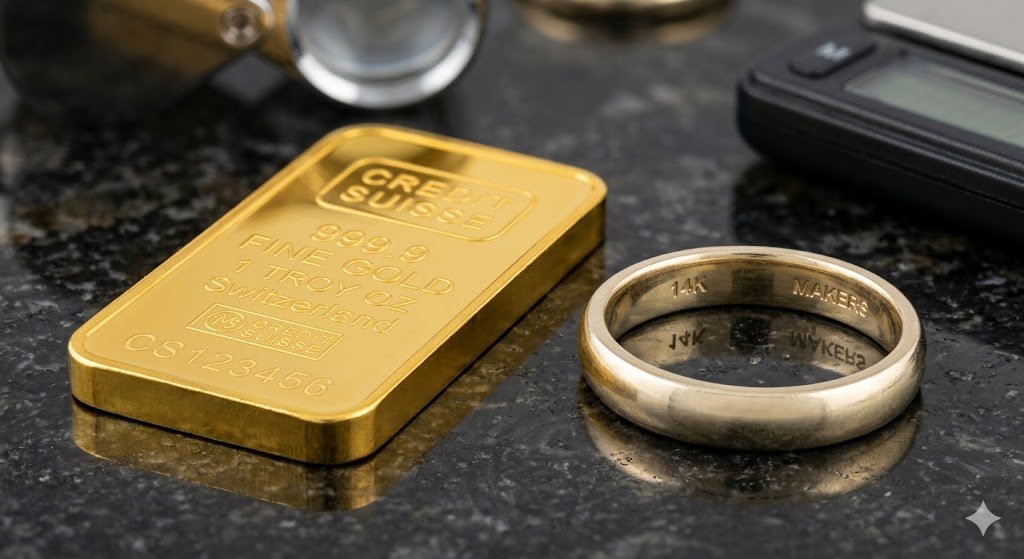
While “Karat” is the common term, professional traders often use “Fineness.” This is a decimal representation of purity parts per thousand. For example, 22K gold is 91.6% pure, which is expressed as 916 Fineness.
Gold Purity Conversion Table
| Karat | Purity Percentage | Fineness (Parts per 1000) | Common Use Case |
| 24K | 99.9% | 999 | Investment Bars & Coins |
| 23K | 95.8% | 958 | High-end Thai Gold Jewelry |
| 22K | 91.6% | 916 | Indian/Middle Eastern Jewelry |
| 18K | 75.0% | 750 | Luxury Watches & Stone Settings |
| 14K | 58.3% | 583 | Standard US/European Jewelry |
| 10K | 41.7% | 417 | Entry-level Durable Jewelry |
The American Perspective: 401k Rollovers and Spot Prices
For the US investor, gold is rarely about adornment; it is a “safe haven” asset. In 2026, as traditional paper assets face headwinds, the Gold IRA has become a staple for retirement diversification.
When you buy a 1-ounce American Gold Eagle, you aren’t just paying for the gold. You are paying the Spot Price (the current market price on commodity exchanges like COMEX) plus a Premium. The premium covers minting, distribution, and the dealer’s profit.
Check Current Gold Spot Prices
Understanding the “Spread”
The spread is the difference between what a dealer will sell gold to you for and what they will pay to buy it back. In the US, high-purity 24K bullion usually has the tightest spreads, making it the most liquid option for those looking to hedge against inflation.
Expert Insight: In a 401k rollover, ensure your gold is “LBMA Approved.” This ensures the purity is guaranteed by the London Bullion Market Association, making it easier to liquidate globally.
The Indian Perspective: 22K, Hallmarking, and Festive Buying
In India, gold is more than an asset; it is Stree Dhan (woman’s wealth) and a cultural cornerstone. During festivals like Dhanteras and Diwali, gold demand spikes, often influencing global prices.
22K vs 24K: The Great Debate
Most Indian jewelry is crafted in 22K (916 gold). If you are buying jewelry for an investment, you must account for Making Charges. These are labor costs that can range from 5% to 25% of the gold’s value. Unlike the gold itself, making charges are rarely recoverable when you sell.
The BIS Hallmark
To protect consumers, the Bureau of Indian Standards (BIS) mandates hallmarking. A hallmarked piece will have the BIS logo, the purity (e.g., 22K916), and a HUID (Hallmark Unique Identification) number. Always verify these before completing a purchase.
Visit World Gold Council for Global Demand Trends
Weight Conversions: Grams, Ounces, and Tolas
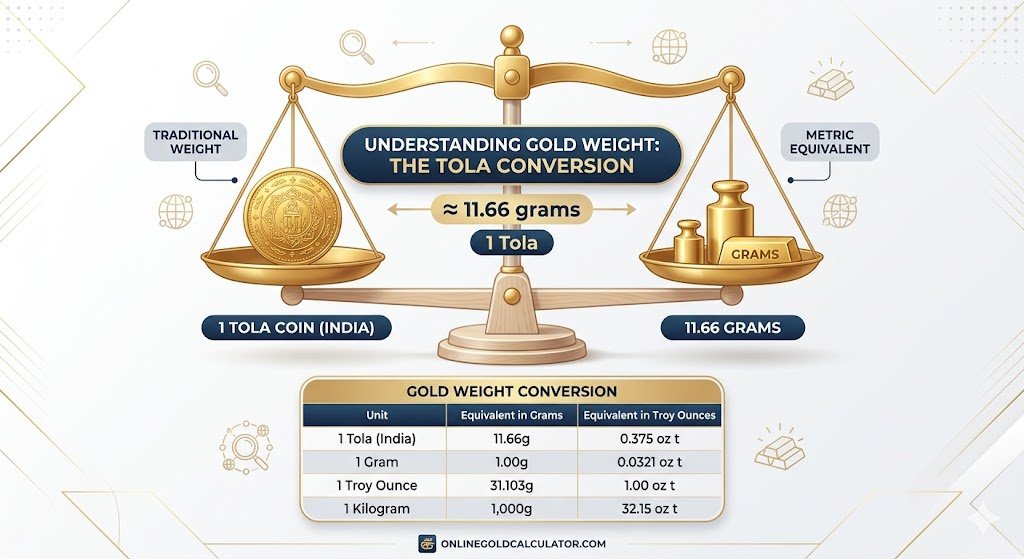
Gold is weighed differently depending on where you are. The standard in the international market is the Troy Ounce, which is heavier than a standard “kitchen” ounce. In India and South Asia, the Tola remains a popular traditional unit.
Gold Weight Conversion Table
| Unit | Equivalent in Grams | Equivalent in Troy Ounces |
| 1 Gram | 1.00g | 0.0321 oz t |
| 1 Tola (India) | 11.66g | 0.375 oz t |
| 1 Troy Ounce | 31.103g | 1.00 oz t |
| 1 Kilogram | 1,000g | 32.15 oz t |
How to Use an Online Gold Calculator
In 2026, there is no reason to guess your gold’s value. A digital calculator uses real-time API feeds from major commodity markets to give you a “penny-accurate” valuation.
- Identify the Karat: Look for the stamp (14K, 18K, 22K, or 999).
- Weigh the Item: Use a digital scale to get the weight in grams or ounces.
- Input into the Calculator: Visit onlinegoldcalculator.com and enter your specs.
- Subtract the Spread: Remember that the result is the melt value. A buyer will typically offer 2% to 5% below this price.
Expert Insight: If your jewelry has heavy gemstones, the calculator’s estimate will be high. Gold buyers only pay for the weight of the metal, not the “dead weight” of non-precious stones.
The Economic Outlook: Why Gold Purity Matters in 2026
As central banks continue to adjust interest rates, the “opportunity cost” of holding gold is constantly shifting. High-purity gold (24K) remains the best inflation hedge because it carries the lowest transaction friction. If the dollar weakens, your 24K gold maintains its purchasing power across borders.
For those in India, the 2026 market has seen a surge in “Digital Gold,” but the physical allure of 22K jewelry remains. By understanding the Karat system, you ensure that your family’s heirloom is not just a beautiful piece of art, but a verified financial safety net.

Frequently Asked Questions (FAQ)
Is 22k gold better for investment than 24k?
No. For pure investment, 24K is better because it contains 99.9% gold and has no “making charges.” 22K is preferred for jewelry because the added alloys make it durable enough for daily wear.
How often do gold prices update on a calculator?
Most professional calculators, like Online Gold Calculator, update every 60 seconds. Gold is a live-traded commodity, and prices fluctuate throughout the day based on global market activity.
What is a “Tola” in Indian gold markets?
A Tola is a traditional unit of weight equal to 11.66 grams. While many modern jewelers use grams, the Tola remains the standard for older generations and traditional wedding sets in India and Pakistan.
Can I use a gold calculator for silver or platinum?
Yes, but you must change the metal setting. Silver and platinum have much lower price points and different purity standards (like .925 Sterling Silver). [Internal Link: Silver Value Calculator].
What is the “Spot Price” of gold?
The spot price is the current market price at which gold can be bought or sold for immediate delivery. It is the baseline used by all dealers before they add their specific markups or premiums.